This bronze sculpture “Sea God Manannan and Voyagers” at Soldiers Point, Dundalk Bay, Co Louth is by the Artist Ann Meldon Hugh. Manannan is the Celtic God of the Sea and is the leader of a group of the Fair Folk whose values and ideals are associated with the water element and the deep blue-green light of the ocean.
1. Water is looked at in paganism as cleansing, healing, psychic, and loving.
2. Water is in accordance with the goddesses Aphorodite, Isis, Mariamme, Mari, Tiamat, Yemaya, and the gods Dylan, Ea, Manannan, Osiris, Neptune, and Poseidon.
3. Water is a feminine element and it is associated with purification.
Facts-
1. Life can’t survive on earth without water.
2. Water is located on Earth, Mars, and Europa (one of Jupiter’s many moons).
3. Water expands wen freezing and contracts when heated.
Come, giant Hekate,
Dione’s guard,
O Persia, Baubo Phroune, dart-shooter,
Unconquered, Lydian, the one untamed,
Sired nobly, torchbearing guide, who bends down
Proud necks, Kore, hear, you who’ve parted gates
of steel unbreakable. O Artemis,
Who, too, were once protectress, mighty one,
Mistress who burst forth from the earth, dog-leader,
All-tamer, crossroad goddess, triple-headed,
Bringer of light, august/virgin, I call you
Fawn slayer, crafty, O infernal one,
And many-formed, Come, Hekate, goddess
Of three ways, who with your fire-breathing phantoms
Have been allotted dreaded roads and harsh
Enchantments.
And then we see again in PGM IV 2811-2228: “…Your ankle is wolf-shaped, fierce dogs
are dear to you, wherefore they call you Hekate…”
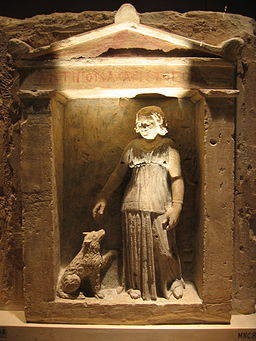
For the Greeks, dogs aided the hunt, guarded crops and
livestock, and were even kept as pets. For pets they seem to prefer a small
lap-dog. We find reliefs with dogs on tombs and vases, and in murals, where they
wait at their human’s feet, and sometimes under tables at dinner. Images
survive which show dogs and children at play or lounging at home together. There
are graves where the dog has been buried with his human, and offerings of dogs
were given to some Chthonic Gods.
Brimo, a goddess in Her own right, and conflated with Hekate
in PGM IV. 2270 and PGM IV. 22607, was also called dog-leader.
We know from both plays and from the surviving spells turned
toward Hekate’s attention that Her worship included the sacrifice of dogs,
particularly black puppies. These offerings seem to have a purificatory power.
By the Roman era, Hekate is sometimes represented with the
head of a dog. Jupiter too, was sometimes called dog-leader, Cynegetes in this
case, and was credited with teaching Arcadia to drive away feral packs. Dogs
were said to guard the Roman temples, and were sacrificed at Lupercalia and
other festivals.
Hekate’s hounds in particular are described as black and
large, which puts them in the same category as several monstrous canines known
to the world. In the Hellenistic era, they were understood to be the souls of
the Restless Dead which haunt the crossroads with their Mistress. Lucian offers
a chilling description of Hekate and her hounds. She is described as vast and
serpentine, with snakes for hair and a serpent tail, and her dogs were larger
“than Indian elephants” and shaggy, matted, and black. Here she carries a torch
and a sword. She opens a chasm and leaps down into Tartarus.
Descriptions of the Deipna often include the warning that
one will hear the call of Her dogs when the meal is laid at the three-way
crossroad, along with an injunction not to look back as you leave.
Most strikingly is the graveyard at Poggio Gramignano in
Teverina, Italy. This is an infant graveyard, full of small children, and dogs.
The archaeologists who have studied the site suspect that some tragedy struck,
because all the graves date to the middle of the fifth century CE. The dog
burials are mostly puppies, and have their own separate burials from the
children. Some of the canid skeletons show signs of a traumatic death. Scholars
likewise suspect that the dogs were sacrificed to Hekate, in light of her
history with puppy and dog sacrifice and her canine characteristics. Plutarch
describes the sacrifice of puppies as involving rubbing the puppy against the
inflicted and sacrificing it to Hekate, suggesting that the puppy played a role
as scapegoat. As a result, some scholars speculate that this graveyard’s dog
graves are evidence of evil-averting exercises dedicated to Hekate after some
sort of plague, in hopes of halting the illness.
Dogs are often associated with Goddesses of birth, and with
some Healing Gods. They are also associated with Ares, who received
dog-sacrifices.
Ultimately, their association with both the haunt of the
Restless Dead and their role as guardians fits well with the dog’s capacity as
guardians as well as their capability for viciousness.
This dichotomy also suits the Goddess that is both Chthonic
and Ouranic, of heaven and earth. Hekate is benevolent and kindly, and terrible
and grim. They share the potential for both natures. It seems natural for
Hekate to take the dogs under her wing.
Today, dog sacrifice is frowned upon, both legally and
ethically, but there are many of Hekate’s devotees who take time to care for
dogs, or to donate time and money to rescues, all in Her name. I myself tithe
money each month and then bundle the donations to a charity for dogs. I have
volunteered in the past, walking and caring for various animals, and dedicated
the act to Her, even praying to Her on walks with the dogs. It all made for a
deeply inspirational and rewarding practice.
Sources:
Theoi.com
The LSJ lsj.translatum.gr
Bell, John. Bell’s New
Pantheon: or, Historical Dictionary of the Gods, Demi-gods, Heroes, and
Fabulous Personages of Antiquity: Also, of the Images and Idols Adored in the
Pagan World…Bell, 1790.
Betz, Hans Dieter. The Greek Magical
Papyri in Translation, including the Demotic Spells, vol. 1, Univ. Chicago,
1992.
Brown, Thomas. Biographical Sketches and
Authentic Anecdotes of Dogs. Brown, 1829.
Franklin, Alberta Mildred. The Lupercalia.
Columbia, 1921.
Harrison, J. R. “Every Dog has its Day,” in New
Documents Illustrating Early Christianity: Vol. 10: Greek and Other
Inscriptions and Papyri Published 1988-1992. Edited by S.R. Llewellyn et
al. Eerdmans, 2012. Pp. 126-135.
Heath, Malcolm, et al. Religion and
Belief: A Moral Landscape. Cambridge, 2014.
International Council for Archaeozoology. Dogs
and People in Social, Working, Economic or Symbolic Interaction, Oxbow,
2006.
Johnston, Sarah Iles. Hekate Soteira.
Oxford, 1990.
————–. Restless Dead, Univ.
California, 2013.
—————. Note 12 on “The Tablets from Pherae,” in Ritual Texts for the Afterlife: Orpheus and the Bacchic Gold Tablets,
by Fritz Graf and Sarah Iles Johnston, Routledge, 2013.
Ogden, Daniel. Drakon: Dragon Myth and
Serpent Cult in the Greek and Roman Worlds, Oxford, 2013.
————-. Magic, Witchcraft, and
Ghosts in the Greek and Roman Worlds. Oxford, 2009.
Ovid. Fastorum libri sex. Trans. By
Sir James Frazer. Cambridge, 2015.
Soren, David, and Noelle Soren. A Roman
Villa and a Late Roman Infant Cemetery, L’Erma di Bretschneider, 1999.
Images:
Attributed to the Kleibolos Painter. “Hekate with Dog,” black figure kylix,
Archaic period. Via theoi.com.
In case you don’t want to read this whole passage, I have highlighted the offerings.
Traditional offerings to Hekate consisted of a lot of animal sacrifice, but so did most of the Ancient Greek gods. But, her offerings also had components of other kinds. One such example is found in the Argonautica by Apollonius of Rhodes (the edition I quote from is the Penguin Classics Voyage of the Argonaut). In this quote, Medea, the witch priestess of Hekate, instructs Jason on how to make an offering to Hekate:
”Wait for the moment of midnight and after bathing in an ever running river, go out alone in sombre clothes and and dig a round pit in the earth. There, kill an ewe and after heaping up a pyre over the pit, sacrifice it whole, with a libation of honey from the hive and prayers to Hecate, Perses’ only Daughter. Then, when you have invoked the goddess duly, withdraw from the pyre. And do not be tempted to look behind you as you go, either by footfalls or the baying of hounds, or you may ruin everything and never meet your friends alive”
(Page 136, Book III, lines 1002-1044)
The methods used here to perform the offerings were very common for deities like Hekate. She is a chthonic deity which means she resides in the Underworld, or at least lives there sometimes. When performing offerings for these deities and for the dead, they would be poured/sacrificed directly onto the earth, or in most cases a pit that was dug. Also in this passage, we see two offerings: honey and an ewe. Also noticed is the suggestion not to look back. This is quite a common practice when honoring chthonic beings such as Hekate.
Another passage which describes an offerings to Hekate comes from a later Latin (which is probably considered a little less traditional) text that also discusses the workings of the witch priestess Medea:
“As she came Medea stopped before the threshold and the door; covered by the sky alone, she avoided her husband’s embrace, and built two turf altars, one on the right to Hecate and one on the left to Youth. She wreathed these with boughs from the wild wood, then hard by she dug two ditches in the earth and performed her rites; plunging her knife into the throat of a back sheep, she drenched the open ditches with his blood. Next she poured upon it bowls of liquid wine, and again bowls of milk still warm…”
(Ovid’s Metamorphoses page 128 from book VII in the Barnes & Noble Classics edition)
Again, we see the sacrifice of a sheep, but this time, there is the edition of wine and milk.
As seen, though animal sacrifice is a common motif, there are offerings which require no animal bloodshed. The philosopher Porphyry in his work On Abstinence expanded upon this by writing about other offerings given to Hekate:
“He diligently sacrificed to them at proper times in every month at the new moon, crowning and adorning the statues of Hermes and Hecate, and the other sacred images which were left to us by our ancestors, and that he also honored the gods frankincense, and sacred wafers and cakes.”
(Porphyry On Abstinence quoted in Hekate: Liminal Rites by Sorita D’Este)
Porphyry’s quote displays a few offerings: frankincense and sacred wafers and cakes. Incense was a common offering to the gods, and remains so today. However, incense was not usually given to chthonic deities. This is slightly different for Hekate most likely because she was not always in the role of a chthonic deity. She was often honored in an ouranic, or heavenly, aspect. This could account for the offering of frankincense.
Some more offerings recommended are found in Sorita D’Este’s book Hekate: Liminal Rites, which I think is a must read for any Hekate follower. In the book she includes a chart which lists offerings of garlic, mullet, eggs, and cheese. Though this book is modern, these are often commonly accepted as traditional offerings to Hekate. She also references cakes called amphiphon which is described as a “flat cheesecake which was surrounded by small torches” offered to her at the Deipnon.
I have outlined some traditional offerings to Hekate, but I have some of my own that I find she enjoys from my experience honoring her. I have found that candles, scented or unscented, sprinkled with her sacred herbs make good offerings, not only for the evaporation of substance, but for the presence of a flame. As a torch-bearing goddess, I figured she might like fires. Another offering I give to her is just a modification of a traditional one. When offering milk to her, I sprinkle cinnamon in it for extra flavoring. Another thing I have found to be an effective offering is blood. I often give her my blood on festivals and celebrations, but I also offer it to her when I am in serious need of her assistance. These offerings aren’t really traditional, but they have worked well enough for me!
I just finished adding almost 100 more names to the epithet project. Some names have been moved from Parts 2 and 3 into part 1 as my research has continued. Enjoy!



 Ocean's Meadow