Robin Williamson ~ A Tale of the Deeds of the Tuatha Dé Danann
This is how Irish myth was intended to be communicated! The Irish had oral traditions, so poetry and music is how stories were told. It’s amazing to finally hear these stories in a medium they originally came from.
Commonly referred to as Druidism or Druidry, both terms are incorrect.
A Druid is a political title within the Celtic Polytheistic religions equivalent to that of a priest/priestess.
A practitioner of Celtic Polytheism is not called a Druid. Not unless that practitioner is a priest or counselor to other Celtic Polytheists.
Despite common belief, Wicca, and Neo-Druidism are technically not Celtic religions; but rather Celtic inspired or influenced religions.
Celtic Polytheism is not witchcraft. A practitioner of Celtic Polytheism is never called a witch or a wizard.
Celtic Polytheism is actually a family of religions rather than a singular religion itself.
The religion branches are Gaelic Polytheism, Brythonic Polytheism, Gallaecian Polytheism &
Celtiberian Polytheism, Gaulish Polytheism, and Pictish Polytheism.
Each of these religions have regional differences. For example, the gods and stories of Ireland, the Scottish Highlands, and the Isle of Man are mostly the same or similar with minor differences.
All of the Celtic Polytheistic religions are technically extinct, however many stories from Ireland, and Wales have survived in particular.
Modern Celtic religions are referred to as Celtic ReconstructionistPolytheism, or simply Celtic Reconstructionism.
There is not a common pantheon of gods, as there were many different gods in each religion. While some gods appear in multiple religions with different names, majority of Celtic gods are unique to their branches.
Deirdre and Naoise had children, a son Gaiar and a daughter Aebgreine (Also fostered by Manannan)
Symbols – He is said to own a boat named Scuabtuinne (“Wave Sweeper”), a sea-borne chariot drawn by the horse Enbarr ( Aonbarr) a powerful sword named Fragarach (“The Answerer”), and a cloak of invisibility (féth fíada).
, a flaming helmet, and a sword named Fragarach (“Answerer” or “Retaliator”) that could slice through any armour and upon command when pointed at a target could make that target answer any question asked truthfully. He also owned a horse called “Enbarr of the Flowing Mane” which could travel over water as easily as land. Some sources say that, to Manannán, the sea is like a flowery plain.
Mannanán also had swine whose flesh provided food for feasting by the gods, and then regenerated each day
Description – He is said to ride on a chariot across the sea,
According to an oral tradition, prevalent in the Isle of Ma, Manannan had three legs, on which he rolled along on land, wheel-like, always surrounded by a ‘magic mist’: and this is the origin of the three-legged figure on the Manx halfpenny. He often disguises himself while on land, sometimes as a beggar or clown. His magical cloak frequently changes colors.
Notable Legends –
In the Ulster Cycle tale, Serglige Con Culainn (“The Sickbed of Cúchulainn”) Manannán’s wife, Fand, has an ill-fated affair with the Irish warrior Cúchulainn. When Fand sees that Cúchulainn’s jealous wife, Emer is worthy of him (and accompanied by a troop of armed women), she decides to return to Manannán, who then shakes his magical cloak of mists between Fand and Cúchulainn so that they may never meet again.
The historical Mongán was a son of Fiachnae mac Báetáin, born towards the end of the 6th century. According to legend Fiachnae, who was at war in Scotland, came home with a victory because of a bargain made with Manannán (either by him, or by his wife) to let Manannán have a child by his wife. This child, Mongán, was supposedly taken to the Otherworld when he was very young, to be raised there by Manannán. The Compert Mongáin tells the tale
According to the Book of Fermoy, a manuscript of the 14th to the 15th century, “he was a pagan, a lawgiver among the Tuatha Dé Danann, and a necromancer possessed of power to envelope himself and others in a mist, so that they could not be seen by their enemies.“ It was by this method that he was said to protect the Isle of Man from discovery.
Manannán was associated with a “cauldron of regeneration”. This is seen in the tale of Cormac mac Airt, among other tales. Here, he appeared at Cormac’s ramparts in the guise of a warrior who told him he came from a land where old age, sickness, death, decay, and falsehood were unknown (the Otherworld was also known as the “Land of Youth” (Tír na nÓg) or the “Land of the Living”). As guardian of the Blessed Isles as well as Mag Mell he also has strong associations with Emhain Abhlach, the Isle of Apple Trees, where the magical silver apple branch is found
Fianna is challenged to foot-race by one “Ironbones, son of the king of Thessaly. The race is to be from Benn Étair to Munster. Caílte mac Rónáin, the best runner of the Fianna, is away at Tara. As Fionn mac Cumhaill goes to look for Caílte, he encounters a repulsive giant, the titular bodach, who agrees to run the race on the Fianna’s behalf. As the race begins, the bodach seems to perform very badly, getting up late in the day, long after the challenger has already left. He then turns out to be an extremely swift runner, overtaking Ironbones twice, but he then stops to eat blackberries, or even backtracks after losing his coat. He still wins the race easily, and is later revealed to have been Manannán mac Lir in disguise. This is one of the few legends that connects Manannan to the Bodach, trickster consort of the Cailleach
When Bran the son of Febal had been at sea two days and two nights, “he saw a man in a chariot coming towards him over the sea,” who turns out to be Manannan mac Lir, and who, as he passed, spoke in verse, and said that the sea to him was a beautiful flowery plain:—
“Bran deems it a marvellous beauty In his coracle across the clear sea: While to me in my chariot from afar It is a flowery plain on which he rides about.
What is a clear sea For the prowed skiff in which Bran is, That is to me a happy plain with profusion of flowers, [Looking] from the chariot of two wheels.“
In the tale ”His Three Calls to Cormac“ (IV.11), Manannán tempts the Irish King Cormac mac Airt with treasure, specifically a ”shining branch having nine apples of red gold,“ in exchange for his family. Cormac is led into the Otherworld and taught a harsh lesson by Manannán, but in the end his wife and children are restored to him. Also, Manannán rewards him with a magic cup which breaks if three lies are spoken over it and is made whole again if three truths are spoken.
Manannán has a sense of humour, and cheerfully lowers himself for a joke. The story “Manannán at Play” has him disguised as a beggar and a clown who turns out to be a harper. Whos music eases pain and puts people to sleep by playing songs of the sidhe, That is the way Manannan used to be going round Ireland, doing tricks and wonders. And no one could keep him in any place, and if he was put on a gallows itself, he would be found safe in the house after, and some other man on the gallows in his place. But he did no harm, and those that would be put to death by him, he would bring them to life again with a herb out of his bag.
Sacred Associations – Cranes, horses, pig, salmon, the sea, ships, chariots, the otherworlds and the souls of the dead, triskele


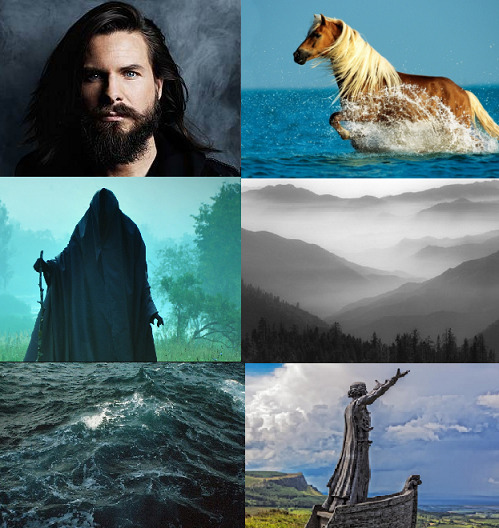

 Ocean's Meadow