Robin Williamson ~ A Tale of the Deeds of the Tuatha Dé Danann
This is how Irish myth was intended to be communicated! The Irish had oral traditions, so poetry and music is how stories were told. It’s amazing to finally hear these stories in a medium they originally came from.
Colours – Red and black, white, purple, and dark blue
Plants – Mugwort, Yew, Willow, Blackthorn and Belladonna
Crystals and metals – Obsidian, Rubies, Jet, Garnet, Bloodstone
Macha is one part of a triple Irish war Goddess called the Morrigan. The name Morrigan means great queen or phantom queen. It can
be spelt in different ways such as Morrigu, Morgane, Morrighan and also Morgan le
Fay in the Arthurian legends.
There are several versions of the other two Goddesses in that triad. They are usually Badb (‘Crow’) and Nemain (‘Frenzy’).
The Celts believed she could revive dead soldiers to fight once
again. The battleground was thought to be sacred after the battle, so the
soldiers would leave until the next day so the Morrigan could gather the souls.
As a scavenger bird, she was an omen of war and fed on bodies and collected
their souls.
Morrigan is also a water Goddess as she rules over rivers
and lakes. One story tells how she appears as an old washer woman at a ford and
offers her love to Cu Chulainne. He failed to recognize Morrigan several
different times. In anger she threatened to thwart him in battle which results
in him being killed. She then appears on his shoulder as a crow.
I pray to the Dé ocus anDé, The Gods of Skill, to lend us your skills In protecting this land.
Help me learn ways to change the polluted waters and desolate soil. Help me learn ways to know the responsible agriculture and farming.
I pray also in ask for your help, Gods of Skill and Gods of Power. Lend us your abilities in protecting this land, this water, this earth.
I pray that everyone may have clean water, I pray that everyone may have edible food, I pray that everyone may have land to live on, I pray that everyone may experience the joys of the seasons and the clouds and the rain.
I pray to you powers of three, Powers of the Gods, Powers of the unGods, Powers of the Ancestors too, and blessings upon blessings upon you all.
When people assume Celtic = Irish I get a strong urge to stab myself in the eye.
No no no no no no.
Sit down we must have a conversation.
There were 6 Celtic nations.
Éire, Cymru, Alba, Kernow, Breizh, and Ellan Vannin.
Ireland, Wales, Scotland, Cornwall, Brittany, and the Isle of Mann respectively.
They’re all related, but not the same. They all have different languages descended from a similar group, Irish (Gaeilge), Scottish (Gàidhlig), Manx (Gaelg), Welsh (Cymraeg), Cornish (Kernowek), and Breton (Brezhoneg). Some are more widely spoken than others, for example Welsh is still commonly spoken in Wales, whereas hearing Cornish in Cornwall instead of English is rare.
All Celtic nations have varied mythology and culture.
Irish Mythology is different from Breton Mythology, and even Welsh and Cornish mythology (arguably the most related Celtic Nations) have subtle differences to each other. I wish I could add more about the cultures at this time but my knowledge of Celtic nations is primarily made up of the history and languages of those regions, particularly Cornwall.
You might have notice that England and English are missing from this, because the English descended from Anglo-Saxons, who were German invaders that came to the isles right around the Fall of the Roman empire in the 5th Century, erasing the Celtic influence in what is now England.
So what this all really means is that Celtic is an umbrella term, and just because it’s Celtic doesn’t mean it has anything to do with Ireland at all. So don’t assume that just because someone’s talking about something Celtic that they’re talking about something Irish.
I actually didn’t know this. Thank you, tumblr person
I love you for this. I love learning and this day started in a good note.
Furthermore there are currently six modern Celtic languages divided into two families. The Goidelic or Gaelic languages: Irish, Scots Gaelic and Manx, which are all descended from Middle Irish; and the Brythonic languages: Welsh, Cornish and Breton all descended from Common Brythonic. It should be noted that both Manx and Cornish are revived languages, that is they effectively died (There were no living native speakers) for a time, but revitalisation efforts amongst the communities to learn the languages as second languages resulted in children picking up the languages as their first language, thus returning the languages to living languages with communities of native speakers. Although all of the languages are growing in number of speakers at each count, only Welsh is not counted as being endangered. This revitalisation is part of why the written form of Manx is so different to that of its sisters, despite the close similarity of the spoken form; its spelling is designed to make sense to a native English speaker, whereas Irish and Gaelic use a more traditional phonetic spelling system which only makes sense if you are used to the concept of a séimhiú being represented by the letter h. The Manx for “Isle of Man”, for example, is “Ellan Vannin” whereas the Irish name is “Oileán Mhanann” while the spelling is very different the actual pronunciation is almost identical. Both refer to Manannán mac Lir of the Tuath dé Danann, an ancient race of supernatural creatures, often interpreted as a christian retelling of the ancient Gaelic gods.
Also, depending on who you ask, there’s a seventh Celtic nation! It’s Galicia, a region in northwestern Spain. Opinions are divided as to whether it’s Celtic enough to “count”, but here are some sources for further reading:
…and I can’t help but link to my own post of the beautiful song “Va unan,” sung in Breton and Spanish by the chorus “L’Ensemble choral du bout du monde” with the Spanish guest vocalist Jesús Cifuentes from the band Celtas Cortos.
I think I’m honor bound to always repost this.
It’s easiest to think of the difference between Goidelic and Brythonic languages as q-Celts and p-Celts. Take the word ‘son of’, for instance, which we’ve all seen in names like MacDonald or MacGregor. Mac. That’s a q-Celtic word, Goidelic, ending in a ‘c’. In Welsh, which is a Brythonic or p-Celtic language, the same word became ‘map’ or ‘ap’. So where the son of Donald in Scotland became MacDonald, in Wales the son of Rhys became ap Rhys became Prys became Price or Preece. Same original root, leading to a very different linguistic end.
Celtic identity and language stretch as far as modern day Turkey or Galatia as it was called. The Galatian Celts were involved with Ptolemaic Egypt both in trade and in their armies.
Deirdre and Naoise had children, a son Gaiar and a daughter Aebgreine (Also fostered by Manannan)
Symbols – He is said to own a boat named Scuabtuinne (“Wave Sweeper”), a sea-borne chariot drawn by the horse Enbarr ( Aonbarr) a powerful sword named Fragarach (“The Answerer”), and a cloak of invisibility (féth fíada).
, a flaming helmet, and a sword named Fragarach (“Answerer” or “Retaliator”) that could slice through any armour and upon command when pointed at a target could make that target answer any question asked truthfully. He also owned a horse called “Enbarr of the Flowing Mane” which could travel over water as easily as land. Some sources say that, to Manannán, the sea is like a flowery plain.
Mannanán also had swine whose flesh provided food for feasting by the gods, and then regenerated each day
Description – He is said to ride on a chariot across the sea,
According to an oral tradition, prevalent in the Isle of Ma, Manannan had three legs, on which he rolled along on land, wheel-like, always surrounded by a ‘magic mist’: and this is the origin of the three-legged figure on the Manx halfpenny. He often disguises himself while on land, sometimes as a beggar or clown. His magical cloak frequently changes colors.
Notable Legends –
In the Ulster Cycle tale, Serglige Con Culainn (“The Sickbed of Cúchulainn”) Manannán’s wife, Fand, has an ill-fated affair with the Irish warrior Cúchulainn. When Fand sees that Cúchulainn’s jealous wife, Emer is worthy of him (and accompanied by a troop of armed women), she decides to return to Manannán, who then shakes his magical cloak of mists between Fand and Cúchulainn so that they may never meet again.
The historical Mongán was a son of Fiachnae mac Báetáin, born towards the end of the 6th century. According to legend Fiachnae, who was at war in Scotland, came home with a victory because of a bargain made with Manannán (either by him, or by his wife) to let Manannán have a child by his wife. This child, Mongán, was supposedly taken to the Otherworld when he was very young, to be raised there by Manannán. The Compert Mongáin tells the tale
According to the Book of Fermoy, a manuscript of the 14th to the 15th century, “he was a pagan, a lawgiver among the Tuatha Dé Danann, and a necromancer possessed of power to envelope himself and others in a mist, so that they could not be seen by their enemies.“ It was by this method that he was said to protect the Isle of Man from discovery.
Manannán was associated with a “cauldron of regeneration”. This is seen in the tale of Cormac mac Airt, among other tales. Here, he appeared at Cormac’s ramparts in the guise of a warrior who told him he came from a land where old age, sickness, death, decay, and falsehood were unknown (the Otherworld was also known as the “Land of Youth” (Tír na nÓg) or the “Land of the Living”). As guardian of the Blessed Isles as well as Mag Mell he also has strong associations with Emhain Abhlach, the Isle of Apple Trees, where the magical silver apple branch is found
Fianna is challenged to foot-race by one “Ironbones, son of the king of Thessaly. The race is to be from Benn Étair to Munster. Caílte mac Rónáin, the best runner of the Fianna, is away at Tara. As Fionn mac Cumhaill goes to look for Caílte, he encounters a repulsive giant, the titular bodach, who agrees to run the race on the Fianna’s behalf. As the race begins, the bodach seems to perform very badly, getting up late in the day, long after the challenger has already left. He then turns out to be an extremely swift runner, overtaking Ironbones twice, but he then stops to eat blackberries, or even backtracks after losing his coat. He still wins the race easily, and is later revealed to have been Manannán mac Lir in disguise. This is one of the few legends that connects Manannan to the Bodach, trickster consort of the Cailleach
When Bran the son of Febal had been at sea two days and two nights, “he saw a man in a chariot coming towards him over the sea,” who turns out to be Manannan mac Lir, and who, as he passed, spoke in verse, and said that the sea to him was a beautiful flowery plain:—
“Bran deems it a marvellous beauty In his coracle across the clear sea: While to me in my chariot from afar It is a flowery plain on which he rides about.
What is a clear sea For the prowed skiff in which Bran is, That is to me a happy plain with profusion of flowers, [Looking] from the chariot of two wheels.“
In the tale ”His Three Calls to Cormac“ (IV.11), Manannán tempts the Irish King Cormac mac Airt with treasure, specifically a ”shining branch having nine apples of red gold,“ in exchange for his family. Cormac is led into the Otherworld and taught a harsh lesson by Manannán, but in the end his wife and children are restored to him. Also, Manannán rewards him with a magic cup which breaks if three lies are spoken over it and is made whole again if three truths are spoken.
Manannán has a sense of humour, and cheerfully lowers himself for a joke. The story “Manannán at Play” has him disguised as a beggar and a clown who turns out to be a harper. Whos music eases pain and puts people to sleep by playing songs of the sidhe, That is the way Manannan used to be going round Ireland, doing tricks and wonders. And no one could keep him in any place, and if he was put on a gallows itself, he would be found safe in the house after, and some other man on the gallows in his place. But he did no harm, and those that would be put to death by him, he would bring them to life again with a herb out of his bag.
Sacred Associations – Cranes, horses, pig, salmon, the sea, ships, chariots, the otherworlds and the souls of the dead, triskele
The Morrígan is often described as a trio of individuals, all sisters, called ‘the three Morrígna’. Although membership of the triad varies, the most common combination in modern sources is Badb, Macha and Nemain. However the primary sources indicate a more likely triad of Badb, Macha and Anand
Sometimes she appears as one of three sisters, the daughters of Ernmas: Morrígan, Badb and Macha. Sometimes the trinity consists of Badb, Macha and Anand, collectively known as the Morrígna. However, the Morrígan can also appear alone and her name is sometimes used interchangeably with Badb
Badb: A war Goddess associated with battle, destruction, and death and often appeared over battle as a hooded crow, or ran alongside warriors disguised as a grey-red wolf. Badb was connected to rebirth as a watcher of the cauldron of regeneration in the Otherworld. She was also a Witch and a sorceress, and a Prophetess who foresaw the future. Macha: The root word “mag” translated means field, plain or pasture. This name connects and gives Macha power over the sacred land and horses, representing wealth, power and symbolizing the elite warriors. She was also connected to fertility by the land and horses, and cursed the male Red Branch warrior to suffer nine days of birth pangs when forced to run a race. As part of the trinity, she rained down fire and blood on her enemies. Nemain: Her name translates to panic, frenzy or venomous. Also a deity of battle, death and destruction, she appeared as a carrion crow. Neiman was a prophetess and her battle cries meant death would soon follow. By shrieking furiously, she intimidated, panicked and confused soldiers on the battle field into dying of fright or mistaking their own comrades for enemies. This aspect connects to the role of Banshee.
Notable Legends – In the Ulster Cycle, Táin Bó Regamna (The Cattle Raid of Regamain), which is a body of Irish mythology, Morrigan appears to the hero Cuchulainn (whom she has appeared to in different guises) and he finds her stealing one of his cows, yet he does not recognize her and becomes angry and insults her. Shape-shifting into a crow, he now recognizes her and acknowledges he would not have insulted her had he known, yet she prophesizes his death in battle which came to pass.
Morrigan also appears to Cuchulainn as a young woman (or hag, depending on the version) and offers him her love, and her aid in the battle, but he rejects her offer. In response she intervenes in his next combat, first in the form of an eel who trips him, then as a wolf who stampedes cattle across the ford, and finally as a white, red-eared heifer leading the stampede, just as she had warned in their previous encounter. (White and red animals were very symbolic of the otherworld and the sidhe)
In the Cath Maige Tuireadh, on Samhain Morrigan has an encounter with the Dagda (High King of the Tuatha De Dannan) before the battle against the Fomorians. When he meets her she is washing battle clothes while standing with one foot on either side of the river Unius and they mate. She then promises to summon the magicians of Ireland to cast spells on behalf of the Tuatha De Dannan and to destroy Indech, the Fomorian king.
Her role was to not only be a symbol of imminent death, but to also influence the outcome of war. Most often she did this by appearing as a crow flying overhead and would either inspire fear or courage in the hearts of the warriors. In some cases, she is written to have appeared in visions to those who are destined to die in battle by washing their bloody armor. In this specific role, she is also given the role of foretelling imminent death with a particular emphasis on the individual.[31] There are also a few rare accounts where she would join in the battle itself as a warrior and show her favouritism in a more direct manner.
The Morrigan was such a powerful symbol of life and birth that the Celts believed she could revive their dead soldiers to fight once more. The severed heads on the battlefield were called the “Mast of Macha” (harvest of Macha). The ground was considered sacred after the battle, as the soldiers would leave until the next day so Morrigan could gather the souls undisturbed. As a scavenger bird, she was an omen of war (both as a symbol and with prophecy) feeding on bodies and gathering souls and terrorized armies into dying of fear with her frightful and shrieking cries.
Although speculated, Morrigan may have been the daughter of Delbaeth and Ernmas whom in the earliest copies of the Lebor Gabala Erenn (The Book of Invasions) had three daughters, named Badb, Macha, and Anand. In the Book of Leinster, Anand is also known as Morrigu, while in the Book of Fermoy version, Macha is identified with Morrigan. In addition, Morrigan may had been one of Dagda’s wives and had sons.
Sacred Associations – Carrion eating animals, specifically crows. Fog, shapeshifting, bloodlust and battle, white and red cows, mugwort, yew, willow, rivers. Obsidian, bloodstone, apples, rebirth, swords, sorcery, bones and skulls.


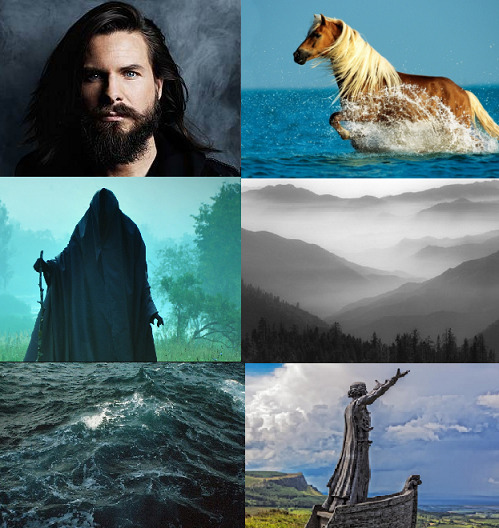

 Ocean's Meadow