Lleu Llaw Gyffes (Lleu of the Skillful Hand), Samildánach (Skilled in All the Arts), Lonnbeimnech (fierce striker, sword-shouter) or Macnia (boy hero).
As to ancestry, Lugh is given the matrinamemac Ethlenn or mac Ethnenn (“son of Ethliu or Ethniu”, his mother) and the patrinamemac Cein (“son of Cian”, his father)
God of – Skill, crafts, music and the arts. oaths, truth and the law. He is sometimes interpreted as a sun god, a storm god or a sky god. The harvest. A renowned warrior god.
Lugh has several magical possessions. He wields an unstoppable fiery spear, a sling stone, and a sword named Fragarach (“the answerer”). He also owns a self-sailing boat named Scuabtuinne (“wave sweeper”), a horse named Enbarr, and a hound named Failinis.
Description –
Notable Legends –
It was said that Lugh’s grandfather, Balor of the Evil Eye, learned that he would one day be murdered by a grandson. He tried to confine his daughter Ethniu, however Cian released her and she bore him three sons. Balor arranged for the children to be killed, however Lugh was saved. Lugh was later given to Tailtiu, a Fir Bolg, who raised him as her foster son.
He is the maternal grandson of the Fomorian, Balor, whom Lugh kills in the Battle of Mag Tuired. His foster-father is the sea god Manannán. Lugh’s son is the hero Cú Chulainn, who is believed to be an incarnation of Lugh.
As a young man Lugh travels to Tara to join the court of king Nuada of the Tuatha Dé Danann. The doorkeeper will not let him in unless he has a skill with which to serve the king. He offers his services as a wright, a smith, a champion, a swordsman, a harpist, a hero, a poet and historian, a sorcerer, and a craftsman, but each time is rejected as the Tuatha Dé Danann already have someone with that skill. But when Lugh asks if they have anyone with all those skills simultaneously, the doorkeeper has to admit defeat, and Lugh joins the court and is appointed Chief Ollam of Ireland. He wins a flagstone-throwing contest against Ogma, the champion, and entertains the court with his harp. The Tuatha Dé Danann are at that time oppressed by the Fomorians, and Lugh is amazed how meekly they accept this. Nuada wonders if this young man could lead them to freedom. Lugh is given command over the Tuatha Dé Danann, and he begins making preparations for war.
When the sons of Tuireann: Brian, Iuchar and Iucharba kill Lugh’s father, Cian (who was in the form of a pig at the time), Lugh sets them a series of seemingly impossible quests as recompense. They achieve them all but are fatally wounded in completing the last one. Despite Tuireann’s pleas, Lugh denies them the use of one of the items they have retrieved, a magic pigskin which heals all wounds. They die of their wounds and Tuireann dies of grief over their bodies
Using the magic artifacts the sons of Tuireann have gathered, Lugh leads the Tuatha Dé Danann in the Second Battle of Mag Tuireadh against the Fomorians. Nuada is killed in the battle by Balor. Lugh faces Balor, who opens his terrible, poisonous eye that kills all it looks upon, but Lugh shoots a sling-stone that drives his eye out the back of his head, wreaking havoc on the Fomorian army behind. After the victory Lugh finds Bres, the half-Fomorian former king of the Tuatha Dé Danann, alone and unprotected on the battlefield, and Bres begs for his life. If he is spared, he promises, he will ensure that the cows of Ireland always give milk. The Tuatha Dé Danann refuse the offer. He then promises four harvests a year, but the Tuatha Dé Danann say one harvest a year suits them. But Lugh spares his life on the condition that he teach the Tuatha Dé Danann how and when to plough, sow and reap.
Lugh instituted an event similar to the Olympic games called the Assembly of Talti which finished on Lughnasadh (1 August) in memory of his foster-mother, Tailtiu
Lugh’s sling rod, named “Lugh’s Chain”, was the rainbow and the Milky Way. Unlike the rod-sling, Lugh had no need to wield the spear himself. It was alive and thirsted so for blood that only by steeping its head in a sleeping-draught of pounded fresh poppy seeds could it be kept at rest. When battle was near, it was drawn out; then it roared and struggled against its thongs, fire flashed from it, and it tore through the ranks of the enemy once slipped from the leash, never tired of slaying.
He appears in folklore as a trickster, and in County Mayo thunderstorms were referred to as battles between Lugh and Balor, so he is sometimes considered a storm god: Alexei Kondratiev notes his epithet lonnbeimnech (“fierce striker”) and concludes that “if his name has any relation to ‘light’ it more properly means ‘lightning-flash’.
Lugh was known as a sun god and a fierce warrior. He is also known as a god of storms, particularly thunderstorms.
Cermait, the son of Dagda, later seduces one of Lugh’s wives. Lugh kills him in revenge, however Cermait had three sons MacCuill, MacCecht and MacGrené/ Gréine, who avenged their father’s death by killing Lugh at Uisnech in Loch Lugborta.
Sacred Associations – Spear, sword, boat, hounds, crows, storms, lynx, The arts, thunder and lightening, poetry, healing, grain
This is a good, thorough rundown for such a short post! My only caveat here would be that Lleu Llaw Gyffes is a Welsh god and is definitely seen to be a espérate entity by many. My own knowledge of Welsh mythology is sparse enough that I don’t have a firm opinion, but thought I’d point that out.
Deirdre and Naoise had children, a son Gaiar and a daughter Aebgreine (Also fostered by Manannan)
Symbols – He is said to own a boat named Scuabtuinne (“Wave Sweeper”), a sea-borne chariot drawn by the horse Enbarr ( Aonbarr) a powerful sword named Fragarach (“The Answerer”), and a cloak of invisibility (féth fíada).
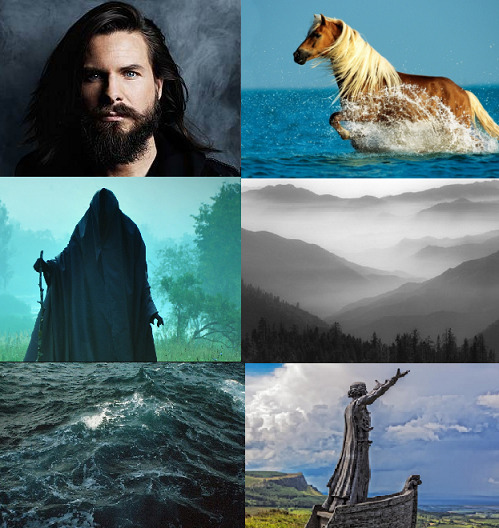
, a flaming helmet, and a sword named Fragarach (“Answerer” or “Retaliator”) that could slice through any armour and upon command when pointed at a target could make that target answer any question asked truthfully. He also owned a horse called “Enbarr of the Flowing Mane” which could travel over water as easily as land. Some sources say that, to Manannán, the sea is like a flowery plain.
Mannanán also had swine whose flesh provided food for feasting by the gods, and then regenerated each day
Description – He is said to ride on a chariot across the sea,
According to an oral tradition, prevalent in the Isle of Ma, Manannan had three legs, on which he rolled along on land, wheel-like, always surrounded by a ‘magic mist’: and this is the origin of the three-legged figure on the Manx halfpenny. He often disguises himself while on land, sometimes as a beggar or clown. His magical cloak frequently changes colors.
Notable Legends –
In the Ulster Cycle tale, Serglige Con Culainn (“The Sickbed of Cúchulainn”) Manannán’s wife, Fand, has an ill-fated affair with the Irish warrior Cúchulainn. When Fand sees that Cúchulainn’s jealous wife, Emer is worthy of him (and accompanied by a troop of armed women), she decides to return to Manannán, who then shakes his magical cloak of mists between Fand and Cúchulainn so that they may never meet again.
The historical Mongán was a son of Fiachnae mac Báetáin, born towards the end of the 6th century. According to legend Fiachnae, who was at war in Scotland, came home with a victory because of a bargain made with Manannán (either by him, or by his wife) to let Manannán have a child by his wife. This child, Mongán, was supposedly taken to the Otherworld when he was very young, to be raised there by Manannán. The Compert Mongáin tells the tale
According to the Book of Fermoy, a manuscript of the 14th to the 15th century, “he was a pagan, a lawgiver among the Tuatha Dé Danann, and a necromancer possessed of power to envelope himself and others in a mist, so that they could not be seen by their enemies.“ It was by this method that he was said to protect the Isle of Man from discovery.
Manannán was associated with a “cauldron of regeneration”. This is seen in the tale of Cormac mac Airt, among other tales. Here, he appeared at Cormac’s ramparts in the guise of a warrior who told him he came from a land where old age, sickness, death, decay, and falsehood were unknown (the Otherworld was also known as the “Land of Youth” (Tír na nÓg) or the “Land of the Living”). As guardian of the Blessed Isles as well as Mag Mell he also has strong associations with Emhain Abhlach, the Isle of Apple Trees, where the magical silver apple branch is found
Fianna is challenged to foot-race by one “Ironbones, son of the king of Thessaly. The race is to be from Benn Étair to Munster. Caílte mac Rónáin, the best runner of the Fianna, is away at Tara. As Fionn mac Cumhaill goes to look for Caílte, he encounters a repulsive giant, the titular bodach, who agrees to run the race on the Fianna’s behalf. As the race begins, the bodach seems to perform very badly, getting up late in the day, long after the challenger has already left. He then turns out to be an extremely swift runner, overtaking Ironbones twice, but he then stops to eat blackberries, or even backtracks after losing his coat. He still wins the race easily, and is later revealed to have been Manannán mac Lir in disguise. This is one of the few legends that connects Manannan to the Bodach, trickster consort of the Cailleach
When Bran the son of Febal had been at sea two days and two nights, "he saw a man in a chariot coming towards him over the sea,” who turns out to be Manannan mac Lir, and who, as he passed, spoke in verse, and said that the sea to him was a beautiful flowery plain:—
“Bran deems it a marvellous beauty In his coracle across the clear sea: While to me in my chariot from afar It is a flowery plain on which he rides about.
What is a clear sea For the prowed skiff in which Bran is, That is to me a happy plain with profusion of flowers, [Looking] from the chariot of two wheels.“
In the tale ”His Three Calls to Cormac“ (IV.11), Manannán tempts the Irish King Cormac mac Airt with treasure, specifically a ”shining branch having nine apples of red gold,“ in exchange for his family. Cormac is led into the Otherworld and taught a harsh lesson by Manannán, but in the end his wife and children are restored to him. Also, Manannán rewards him with a magic cup which breaks if three lies are spoken over it and is made whole again if three truths are spoken.
Manannán has a sense of humour, and cheerfully lowers himself for a joke. The story “Manannán at Play” has him disguised as a beggar and a clown who turns out to be a harper. Whos music eases pain and puts people to sleep by playing songs of the sidhe, That is the way Manannan used to be going round Ireland, doing tricks and wonders. And no one could keep him in any place, and if he was put on a gallows itself, he would be found safe in the house after, and some other man on the gallows in his place. But he did no harm, and those that would be put to death by him, he would bring them to life again with a herb out of his bag.
Sacred Associations – Cranes, horses, pig, salmon, the sea, ships, chariots, the otherworlds and the souls of the dead, triskele
Gaelic Gods aren’t seen as ‘ruler of the skies’ or ‘the Goddess of Love’ like how other deities are. And while there is nothing wrong with the following examples, to try to fit a Gaelic God into that context is to remove them from their cultural and how they were honored. The Morrigan is a war Goddess, but not the Goddess of war.
One of my favorite quotes on this subject is “When we are tackling a strange mythology, we seek instinctively an Olympus where the gods abide,an Erebus, kingdom of the dead, a hierarchy of gods, specialized as patrons of war, of the arts or of love.”
Part of which is caused by the fact that in most of the western world, the Greek myths are taught as the be all end all, all myths follow the same structure. But it simply isn’t true. There might be things associated with the gods, or things that it is known that the Gods enjoy, but that doesn’t necessarily mean that they rule over it. Brighid is known for being a master craftsman, but so are Luchtaine, Goibne, and Creidhne are also all master craftsmen.
When we pigeonhole our Gods, we fail to see them as the complex beings that they truly are. Just as people can have different sides and aspects to them, so too can the Divine.
Cichol – Leader of the Formorians, a race of semi-divine creatures. A being who preceded the gods of Celtic lore. Mannanan – Technically a sea deity but is also associated with the veil between the living and afterlife. Donn – Lord of the dead in Celtic lore.
Egyptian
Anubis – Guardian of the dead, mummification and the afterlife in ancient Egyptian religion. Osiris – Lord of the Underworld. Nephthys – Anubis’ mother, and sister of Osiris, was also a guardian of the dead. She was believed to also escort dead souls to Osiris. Seker – A falcon god of the Memphite necropolis who was known as a patron of the living, as well as a god of the dead. He is known to be closely tied to Osiris.
Greek
Hades – King of Underworld. Persephone – Queen of the Underworld, wife of Hades and goddess of spring growth. Hecate – Goddess of magic, night, moon, ghosts, necromancy and crossroads. Thanatos – Spirit of death and mortality. Macaria – Daughter of Hades, goddess of the blessed death. Melinoe – Daughter of Persephone and Hades (or Zeus disguised as Hades), goddess of the restless undead, (ghosts etc.). Angelos – A daughter of Zeus and Hera who became an underworld goddess. Erebus – The primeval god of darkness, his mists encircled the underworld and filled the hollows of the earth Keres – Goddesses of violent death, sisters of Thanatos. Styx – Goddess of the river Styx, a river that formed a boundary between Earth and the Underworld. Erinyes – Chthonic deities of vengeance
Norse
Odin – God of many things, including death. Hel – Goddess of the dead, presides over a realm also called Hel. Freyja – Goddess of many things but can be associated with death.
Roman
Dis Pater – God of the underworld Mania – Goddess of death Mors – Personification of death Orcus – Punisher of broken oaths; usually folded in with Pluto Pluto – Ruler of the underworld




 Ocean's Meadow